


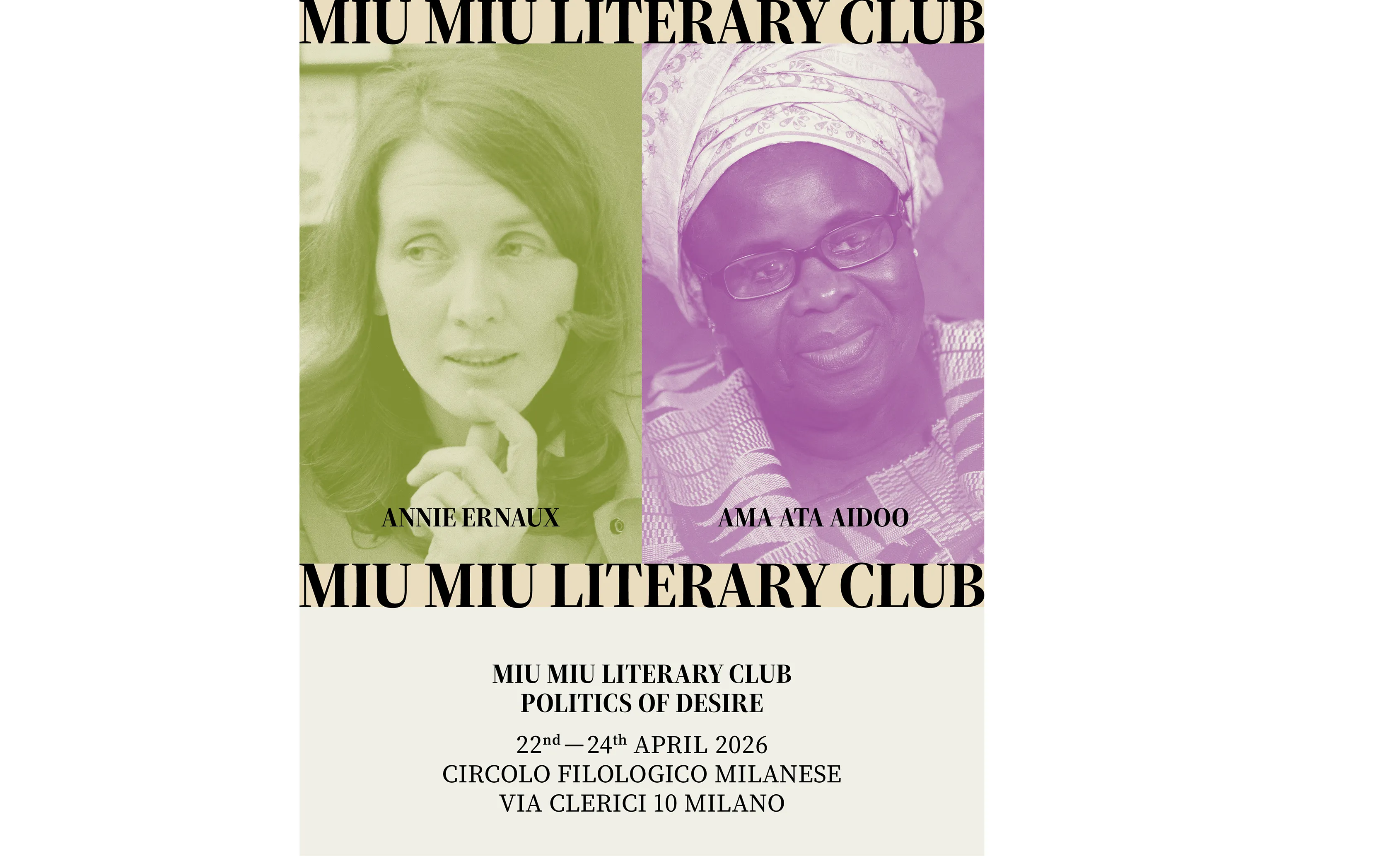
Miu Miu presents Literary Club 2026, “Politics of Desire”, under the direction of Miuccia Prada. Now in its fourth iteration (Milan 2026, 2025, 2024 - Shanghai 2025), this year’s event continues the aim to strengthen Miu Miu’s dialogue with contemporary culture, fostering a discourse on sexuality, desire and consent. From the personal to the political, and from literature to life, desire is a force that determines the right to exercise self-determination - a radical act of resistance.
As always, the work of two highly revered and distinctive authors is the starting point from which to broaden any debate. This year, they are Nobel prize-winning, French-born Annie Ernaux with A Girl’s Story (2016), and one of the most authoritative figures in African literature and an icon of post-colonial feminist thought, Ama Ata Aidoo with Changes: A Love Story (1991). Taking place over three days, Miu Miu Literary Club takes inspiration from Europe’s rich heritage of literary salons and is located at Circolo Filologico Milanese in Milan. In addition to the panel conversations, for the first time this year, two lectures will be introduced as a moment of intellectual exploration, inviting participants to reflect on how literature can serve as a medium to deconstruct roles and identities.
The programme begins on April 22nd with “A Girl’s Story” by Annie Ernaux, a panel discussion based on the book of the same name. Born in France in 1940, Ernaux is a celebrated pioneer of auto-socio-biography and, most famously, author of historical memoir The Years (Les Années, 2008). This more recent work, originally published in France in 2016 and in English in 2020, dissects the pivotal summer of 1958, when camp counsellor, 18-year-old Annie, has her first sexual experiences. Between her younger self naive perspective and her adult understanding, protagonist Annie analyses the chasm of the sexual politics and power dynamics that have shaped her identity and ultimately sparked her writing life.
This first conversation explores the complex intersections of desire and consent, examining how social expectations shape the shared understanding of personal experience. It highlights the transformative power of memory as a testament to self-ownership and resilience. The themes will be explored by a multidisciplinary group of speakers: French German journalist and author Annabelle Hirsch; prominent feminist thinker, and author Lea Melandri; and Irish-born, New York-based author and journalist Megan Nolan. The discussion will be moderated by British writer and curator Lou Stoppard, returning to the Literary Club for the third year.
Later the same day, the first lecture takes place. Entitled “Desire After AI”, cultural theorist Olga Goriunova talks about her most recent book, Ideal Subjects. The Abstract People of AI (2025), which examines how our lives and daily behaviours have come to reside in the world of data and artificial intelligence as they form ideal subjects - and how desire becomes oriented towards such abstractions - presenting an uncanny and fascinating portrait of modern subjectivity in the technological age. This condition poses new dangers: while we know how to resist older norms and categories, the new ideal subjects of AI seem personalised and prolific. This requires a new politics of desire. Goriunova is introduced by Jennifer Guerra, an Italian journalist and writer known for her work specialized in gender studies and LGBTQ+ rights. Guerra integrates nomadic subjectivity into her analysis of contemporary right and desire.
“Changes: A Love Story” is the title of a conversation which kicks off day two of the Literary Club on April 23rd and is built around Ama Ata Aidoo’s most famous work. A leading feminist voice in African literature, Aidoo is the first published female African dramatist, with her play The Dilemma of a Ghost (1965). She served as Ghana’s Minister of Education from 1982 to 1983, resigning when she was unable to make education freely accessible to all. She is the founder of the Mbaasem Foundation to support African women writers. Through her work, Aidoo has consistently explored the complexities and challenges of the lives of African women in post-colonial societies. Originally published in 1991, Changes: A Love Story, which won the 1992 Commonwealth Prize tells the story of a middle-aged Ghanaian woman who divorces her abusive husband and enters a polygamous marriage with the illusion of preserving her independence. This choice becomes a poignant lens through which to examine the complex intersections of modernity, tradition, and female agency. Here, desire becomes a tool of political negotiation: intimate choices confront patriarchal and cultural structures. In this conversation internationally renowned personalities explore the transformative power of self-determination and the challenges of modern love: Italian novelist, screenwriter, Francesca Marciano, Liberian-American author Wayétu Moore, and Surinamese-Dutch anthropologist and Emerita Professor of Gender Studies Gloria Wekker are moderated by journalist, author, critic Nadia Beard.
This conversation is followed by the lecture “How Do We Talk About Consent?”, author Katherine Angel - whose book Tomorrow Sex Will Be Good Again: Women and Desire in the Age of Consent (2021) explores sex in contemporary society - examines how, in the name of consent and empowerment, women are often urged to proclaim their desires clearly and confidently, even though the conditions for sexual desire in a world full of constraint and unease are not always favorable to eroticism. She advocates for a sexual ethic rooted in mutual vulnerability and not-knowing. Angel is introduced by Elisa Cuter, a film critic working on cinema, politics, and sexuality at the Filmuniversität Babelsberg Konrad Wolf in Germany.
Conversations and lectures - curated by Olga Campofreda, a writer and researcher of Italian culture, language, and literature - in collaboration with feminist philosopher Rosi Braidotti, will be followed on both days, by live music performances, as well as prose and poetry readings.
For the first time, Miu Miu Literary Club is hosting a “Curated Library” for consultation and inspiration, by Rosi Braidotti, installed within the Circolo Filologico and featuring a selection of titles focused on the power of writing as a creative medium that has, for centuries, enabled women to voice their desires, ideals, and affirm their independence.
Finally, for 2026, the Literary Club introduces an additional day of programming. Open to the public on April 24th, the Circolo Filologico will be transformed into a reading room where visitors can pass by and read or explore the selection of books from the library curated by Rosi Braidotti. Designed to enrich cultural dialogue and a sense of community, this final, less structured moment aims to encourage discourse and enhance and cement the power of the written word.
Throughout the three days, copies of A Girl’s Story and Changes: A Love Story will be available for this occasion.
Registration to attend Miu Miu Literary Club opens on April 13th on miumiu.com


